livewall
← All articles
Engagement24 February 2026·Livewall

How to design a campaign microsite that actually converts

Campaign microsites fail for predictable reasons: too much brand story, not enough participation mechanic. Here's how to reverse that ratio.

campaignsweb-appsbrand-activation

Most campaign microsites are digital brochures

Building a microsite is easy. Building one that gives people something to do, brings them back, and produces data worth having: that is a different challenge entirely.

We see it repeatedly at Livewall. A brand invests in a beautifully designed campaign environment. Strong animations. Tight copy. Visually consistent with the wider identity. And yet the bounce rate is high, session time is low, and conversion disappoints.

The cause is almost always the same: the microsite was built as a presentation, not as a participation experience.

People arrive, look around, and leave. There is nothing to do. No reason to return. No incentive to share.

That is not a visual problem. It is a design problem.

Livewall perspective

A microsite that converts is not a good-looking brochure. It is an environment where something is asked of you, and something is in it for you.

The ratio between brand story and participation mechanic

The first question to ask when designing campaign microsites is not: how should this look? The question is: what does a visitor actually do here?

A well-designed microsite has a clear ratio between content and interaction. A rough guide: no more than 40% brand story, at least 60% participation. In practice, most microsites have that exactly the wrong way around.

Participation can take many forms. A quiz. A collect-and-win mechanic. A personalised outcome. An upload moment. A vote. A daily return action.

The point is not that it is enjoyable to do, though that helps. The point is that the visitor has a reason to return, share, or leave their details.

When we design interactive campaigns at Livewall, we always define the target behavior first. Do you want repeat visits? Data collection? Viral sharing? That behavior defines the mechanic, not the other way around.

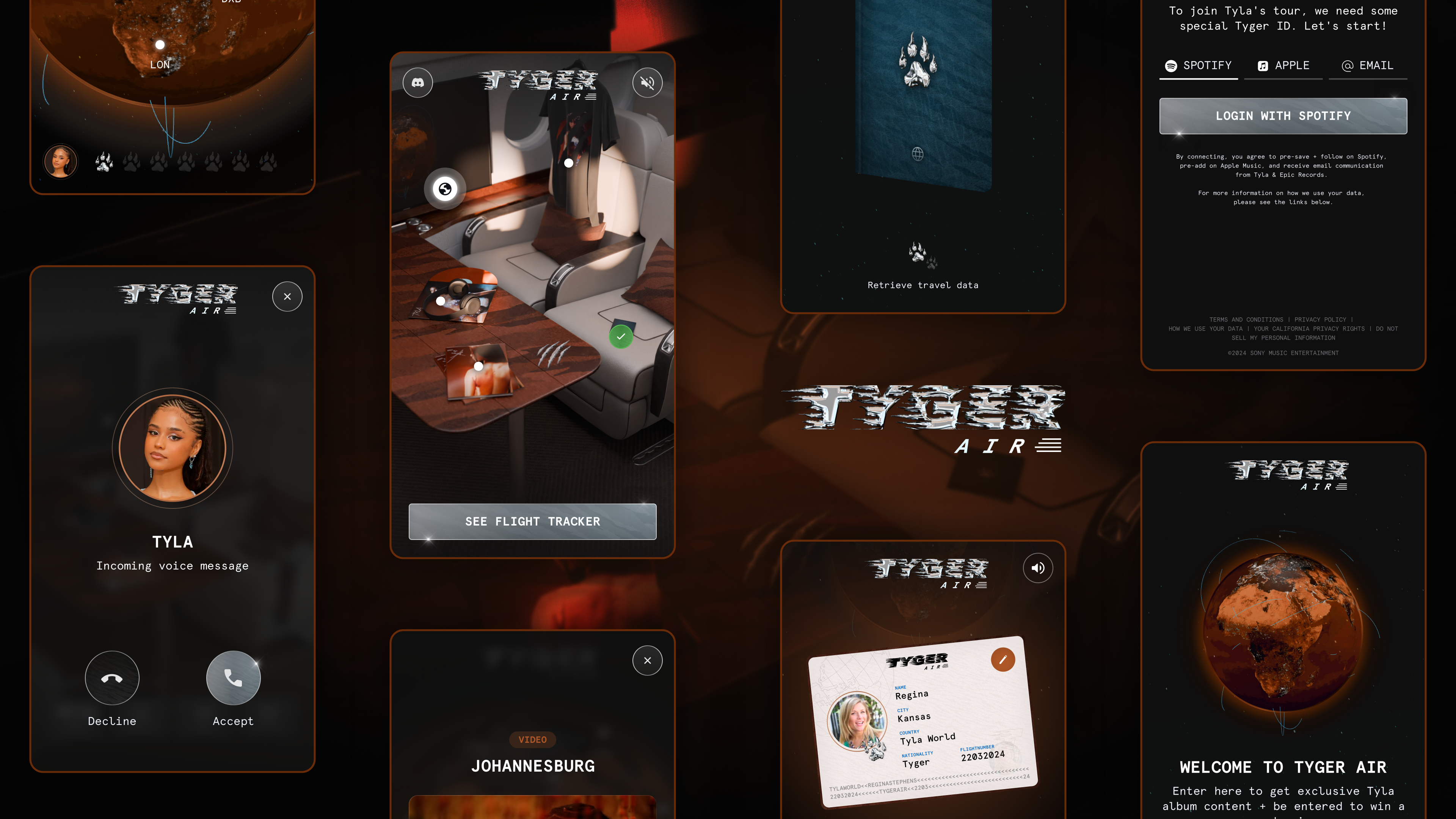
Tyger Air campaign microsite - immersive fan experience for Tyla

Tyger Air: a microsite built around a personal digital passport for fans of Tyla.

Four design principles for campaign microsites that convert

1. Give the visitor a clear objective

The best campaign microsites give visitors a mission. Not: "discover our new collection". Instead: "play every day for a chance to win" or "build your profile and compare with friends".

A clear objective creates return behavior. And return behavior is what drives session depth, engagement rates, and conversion.

2. Design for sharing, not just for looking

Visually strong is good. But ask yourself about every element: what is the shareable moment here? A personalised card. A score. A result that reveals something about the user.

For the Martin Garrix Dream Team campaign, we used Spotify API integration to generate personal share cards. Those cards spread organically because they were unique per person. The brand gained reach without buying media for it.

3. Build for return visits

A microsite that earns only one visit wastes your media budget. Daily mechanics, unlockable prizes, progress indicators: these are the instruments that bring people back.

For Wehkamp Wanna Have Days, we built a collect-and-win mechanic where customers returned daily to unlock new digital cards. Repeat visits were not the outcome, they were the design objective.

4. Collect data through participation, not forms

A sign-up form is not a participation mechanic. People share their data when they feel they are getting something in return. A quiz that teaches them something. A mechanic that personalises their result. A moment where they see what their participation earns them.

This is the foundation of first-party data mechanics. The data is a byproduct of a good experience, not a goal made visible to the user.


3xhigher return visit rate on microsites with daily participation mechanics
60%of sessions end without an action on microsites with no clear objective
4xmore first-party data collected through interactive mechanics vs standard opt-in forms

Technical choices follow behavior

A common mistake is starting from the technology stack or the platform. A campaign microsite is not a CMS implementation. It is a behavior environment.

That means the technical choices follow what the participation mechanic requires. Do you need real-time leaderboards? Build a backend that handles that. Do you want daily variable content? Serverless and edge rendering is the right call.

At Livewall, we build campaign microsites as full web applications, not as CMS pages with a widget plugged in. That gives us the freedom to build the mechanic the campaign deserves, without compromising the behavioral design.

It is also why many agencies fail at this: they start with a template and try to fit a mechanic into it. We start with the behavior and build the technology around it.

Measuring what matters

The KPIs of a campaign microsite are not pageviews and unique visitors. Those tell you about reach, not about behavior.

What actually matters:

  • Return rate: how many visitors come back after day one?
  • Participation rate: what percentage of visitors complete an action?
  • Share propensity: is content being shared, and by whom?
  • Data quality: are the data points richer than name and email?

None of these improve with better graphic design or faster load times. They improve with the participation mechanic.

That is the core of how Livewall approaches campaign microsites: behavior first, aesthetics second.

Livewall

A campaign microsite that does more than present

At Livewall, we design campaign environments that give visitors something to do. From mechanic design to technical build, one team handles it all.

Get in touch with our team

What we do

Livewall builds brand experiences that people actually remember — interactive campaigns, loyalty platforms, digital products, and employer branding for ambitious brands.

Our work

We've worked with HEMA, Stabilo, Wehkamp, Efteling, 9292 and many others. Every project starts with the same question: what would make someone actually want to do this?

Talk to us

Working on something similar? We'd love to hear about it.

Contact Livewall →