

Most family-facing brand activations fail not because the idea is wrong, but because the brief only addressed one audience. A product quiz works for an adult but loses a child in the first ten seconds. A colouring page with a mascot entertains the child but leaves the parent standing there with nothing to do.
At Livewall, we see this pattern constantly in FMCG and retail campaigns targeting families. The problem is not the category. It is the design. A genuine family activation needs two layers, each functioning independently, but together creating something that neither group would experience alone.
Two registers, not one audience
Children and parents are not a shared audience that a single approach can serve. Their motivations are fundamentally different. Children want to play, discover, and win. Parents want to feel in control, not wait around, and ideally get something out of the experience too.
Good activation design acknowledges this gap and builds into it. The child-facing layer has to be genuinely fun, not advertising dressed up as fun. The moment a child recognises they are playing a commercial, the engagement collapses. The parent-facing layer does not need to be interactive. But it needs to offer something: information, a reward, a moment of connection, or simply a clear ending that makes the time feel worthwhile.
What works in practice
The most successful formats we have built at Livewall pair a fluid play experience for the child with a result moment for the parent. That result can be a discount code, a summary of what the child achieved, a shared prize draw, or simply a natural stopping point that both can walk away from satisfied.
For Mitsuba, we built the Spice Rush game: a playable brand moment around flavour discovery, designed for trade shows and events. The mechanic is simple enough for children to pick up immediately but quick enough that adults enjoy it too. The brand benefits from real time-with-product instead of passive demonstration.
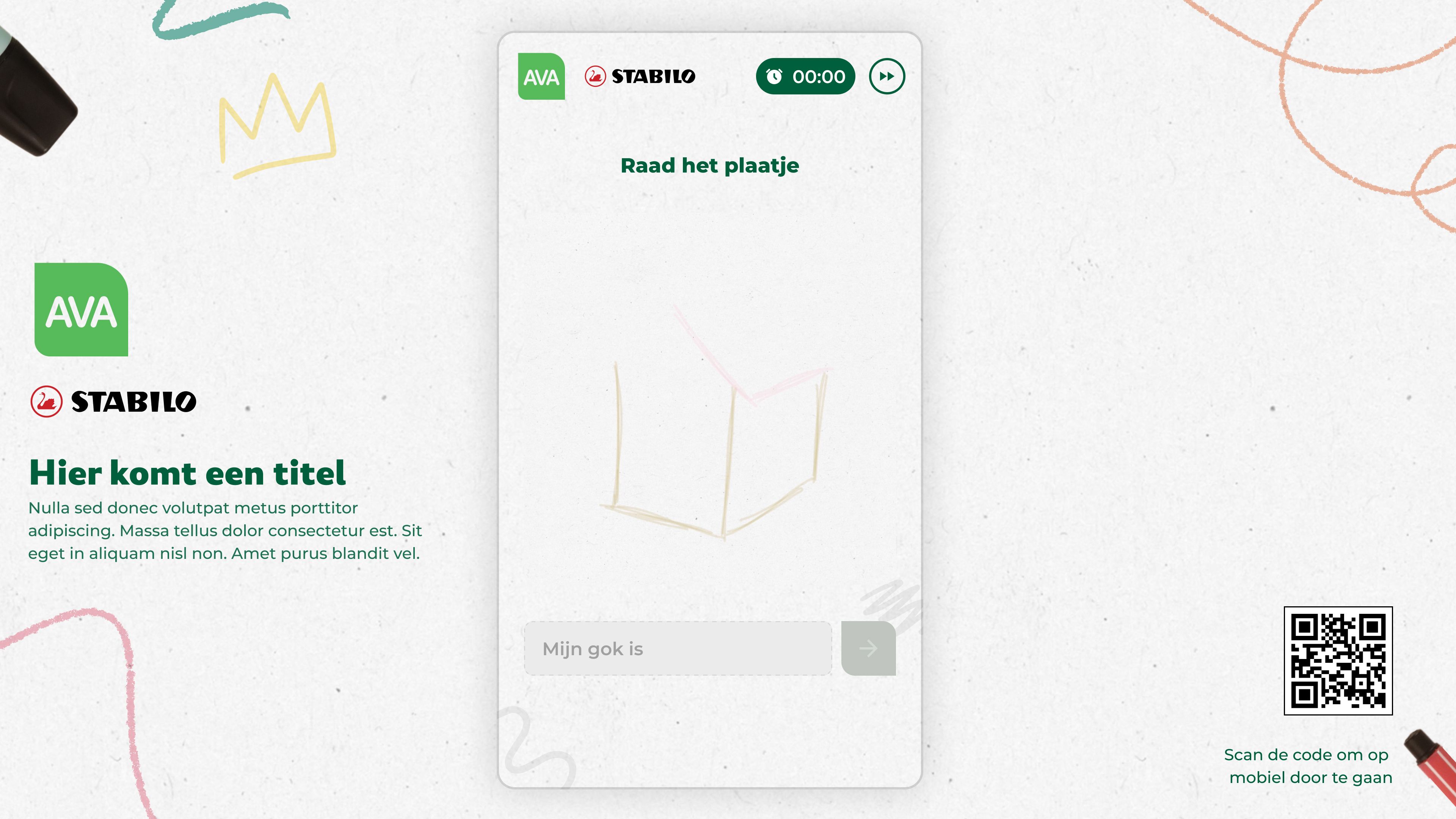
For Stabilo, we created Stabilo Pictionary: a live draw-and-guess game that works perfectly across age groups. Children draw, adults guess, and the product sits at the centre of the experience without ever feeling like promotion.
The most common mistake
A pattern we see regularly: the activation is designed for the parent but delivered through the child. The child is asked to fill in a form, upload a photo, or hand over a parent's email address. This does not work. Children sense when they are being used as a funnel, and parents do too.
The gamified activation that actually generates results gives the child a meaningful role with genuine stakes. The child plays, earns points, reaches a level, unlocks something. Then, as a consequence of that achievement, there is a moment for the parent. That sequence matters.