

livewall
← All articles
Strategy27 March 2026·Livewall

What a behavioural design agency actually does (and why it's different)

Behavioural design is a phrase a lot of agencies have adopted. Here's what it means in practice, how it shapes the work, and why the difference is visible in the output.

digital-productsgamificationbrand-activation

What behavioural design actually means

A lot of agencies say they do behavioural design. What they usually mean is that they build polished interfaces with thoughtful UX. That is not the same thing.

Behavioural design starts from a different question. Not "how do we make this look good?" but "what behaviour do we want to trigger, and what does someone need at this moment to take that step?". That shift in framing changes everything: how you brief a project, the decisions made during build, and what ends up in the final product.

At Livewall, we work from this principle. We design interactions that move people toward a specific action, not just interactions that entertain them. It sounds like a subtle difference. It is not. It is visible in every project we deliver.

Livewall perspective

Behavioural design does not ask how to make something beautiful. It asks what behaviour you want to trigger, and what someone needs right now to do it.

The three layers every project passes through

In practice, we work with three layers that run through every project.

Motivation. What is driving this person right now? What do they want to achieve, avoid, or experience? A new employee wondering whether they made the right career choice has a very different motivation than a customer browsing a loyalty offer. The motivation layer determines tone and narrative.

Ability. Can someone perform the behaviour without friction? Complexity is the silent killer of every engagement design. We design so that the step we are asking for always feels smaller than the reward attached to it.

Prompt. Is there a trigger at the right moment? The most well-designed experience fails if the prompt is absent or poorly timed. We design triggers that feel logical and inviting rather than intrusive.

These three layers draw on the Fogg Behavior Model, but how you apply them depends entirely on context. A loyalty programme calls for different motivation insights than a pre-boarding tool.

HEMA Stapelgek loyalty activation

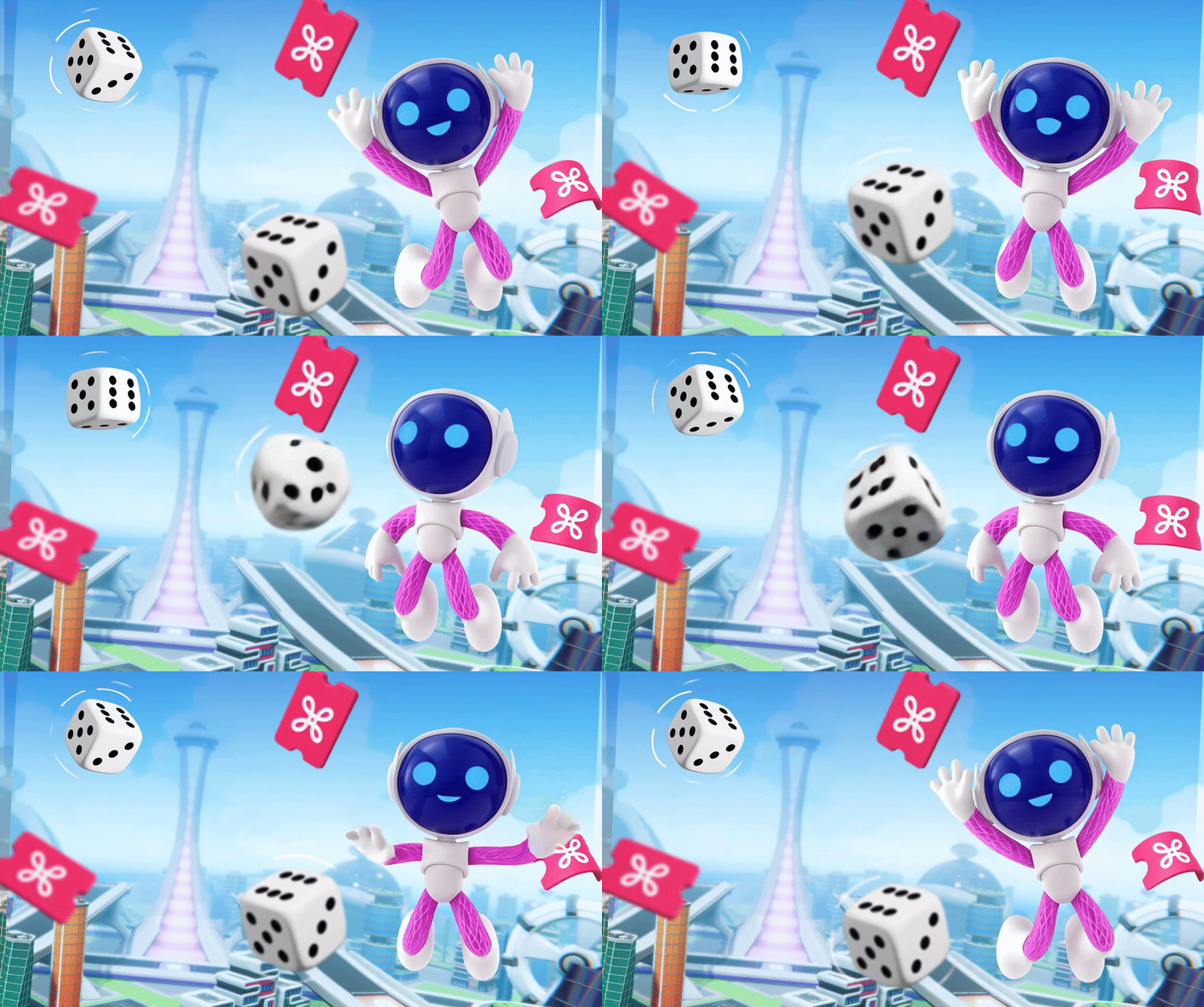
HEMA Stapelgek: turning everyday purchases into app engagement through game mechanics

How this differs from standard UX work

Good UX is necessary. But UX work is primarily focused on removing friction: make it work, make it understandable, remove obstacles. That is essential.

Behavioural design goes a step further. It adds direction. We do not only want people to be able to do something, we want them to actually do it, and to come back regularly. That requires deliberate choices around reward structures, progression systems, social mechanics, and narrative layers.

For HEMA Stapelgek, the challenge was not to build a nice app. The challenge was to connect everyday purchases to a play experience that genuinely bonded customers to the app. That required understanding which moment in the customer journey carried the most motivation, and which game structure fit that moment.

For Decathlon, the goal was to reward members for daily movement rather than purchases. That is a fundamentally different behaviour model than a classic points programme. Every design decision follows directly from that insight.

Gamification is a means, not a goal

A common mistake is treating gamification as a separate layer you apply on top of a product. Points, badges, levels. That works sometimes, but the starting point is wrong.

Gamification is only effective when it reinforces the behaviour you already want to trigger. It is not a coating. It is structure. And that structure needs to fit the user's motivation and the moment they are using the product.

For Mitsuba Spice Rush, we designed a trade show activation that introduced visitors to the product range through play. The game element was not decorative. It was the direct route to product discovery, designed as an experience flow that matched how trade show visitors absorb information.

The same principle applied to the McDonald's Condiment Rush gamified learning for McDonald's UK, where kitchen operations were turned into fast-paced gameplay so that crew learn daily tasks by doing rather than reading.

Why the difference shows up in the output

The difference between a behavioural design agency and an agency that builds beautiful things only becomes clear when you look at what comes out.

Ask yourself: does the experience have a clear behaviour path? Does the user know at every moment what the next step is and why it is worth taking? Is there a mechanism that rewards return behaviour? Does the reward structure match what the user intrinsically wants?

At Livewall, we always start by defining the behaviour we want to produce before determining a single design element. That sounds methodical, but in practice it means our creative choices always have a function. Every game element, every notification, every progress indicator is placed with intent.

The Proximus+ World experience is a good example. A brand world for a telco operator that guides users through services and offers via an immersive environment. The layout is not arbitrarily beautiful. It follows a designed path that brings users to precisely where brand and conversion goals benefit most from their attention.

3xhigher repeat participation in behaviour-driven campaigns versus standard promotions
68%of users return within 7 days when return-loop mechanics are well designed
40%higher onboarding completion rate in pre-boarding tools with behaviour-led progression

Behavioural design across the four service areas

At Livewall, we apply behavioural design across four areas.

Engagement is about triggering participation and sustaining attention during campaigns and activations. Getting people to take part, and to come back.

Loyalty is about anchoring behaviour in the longer-term relationship. Which mechanisms make customers choose your brand even when it is easier to go elsewhere?

Digital Products are platforms and applications that people use daily. Behavioural design determines how habits form around the product.

Employee Experience is about employee behaviour. How do you make new hires feel genuinely connected before their first day? How do you make training something people want to do rather than have to do?

The method is the same across all four. The application varies by context.

Livewall

Working on an experience that needs to drive behaviour?

At Livewall, we start every project by defining the behaviour you want to produce. If you want to explore what behavioural design looks like in your context, get in touch.

Get in touch with our team

What we do

Livewall builds brand experiences that people actually remember — interactive campaigns, loyalty platforms, digital products, and employer branding for ambitious brands.

Our work

We've worked with HEMA, Stabilo, Wehkamp, Efteling, 9292 and many others. Every project starts with the same question: what would make someone actually want to do this?

Talk to us

Working on something similar? We'd love to hear about it.

Contact Livewall →