


livewall
← All articles
Strategy7 January 2026·Livewall

What the best consumer apps teach us about brand digital products

TikTok, Duolingo, and Strava earn daily opens without paying for them. Here is what brand digital products can learn from how these products are designed for return visits.

digital-productsuxbrand-activation

Most people open TikTok without consciously deciding to. They open Duolingo because an owl told them to. They open Strava because a friend already posted their run. No paid ad, no push campaign. Just a product designed to bring them back.

Brand digital products rarely start that way. They launch with a campaign budget, perform well in month one, and then plateau. The question is not whether you can build an app or a platform. The question is whether you can build something people choose to return to, without being paid to do so.

At Livewall, we design and build digital products for consumer brands. We see the same pattern repeatedly: brands invest heavily in the launch and almost nothing in the behavioral layer that drives return. That is exactly what the best consumer apps do differently.
Livewall perspective

The best consumer apps did not go viral. They were carefully designed so that returning is the easiest choice a user can make.

The three principles behind every return visit

1. The next step is always obvious

Duolingo never makes you wonder what to do next. The streak counts. The next lesson is ready. The progress bar moves visibly. Every element says: you are not done yet, but you are almost there.

Brand platforms miss this almost universally. Users log in, see a dashboard, and do not know why they are here. There is no open loop, no next step, no reason to come back tomorrow.

Good UX/UI design for brand digital products does not start at the homepage. It starts with a question: what does the user do next, and the day after that?

2. Progress is visible and personal

Strava shows you how far you have come. Literally in kilometres, but also in leaderboards, badges, and the reactions of your friends. The progress feels owned. You do not want to let it lapse.

This is what makes collect-and-win mechanics effective when they are done well: not the prize, but the feeling of building something. We see this consistently in loyalty programs that actually work.

3. Social connection reinforces habit

TikTok is not a solo platform. Every video is a response to something else. Your activity is connected to the activity of others. That network effect makes leaving harder.

The same applies to brand platforms. A community that contributes, responds, and stays connected is a community that comes back. Not because of the brand, but because of each other.

Proximus+ World branded digital environment

Proximus+ World: a branded digital environment designed for returning interaction

Habit-forming design in practice

Habit-forming design is not a trick. It is a design decision that has to be made early in the process. What action do you want users to take every day, every week, or every month? What gives them a reason to return when there is nothing new?

The answers to those questions determine the architecture of your product. They are not something you add on afterwards.

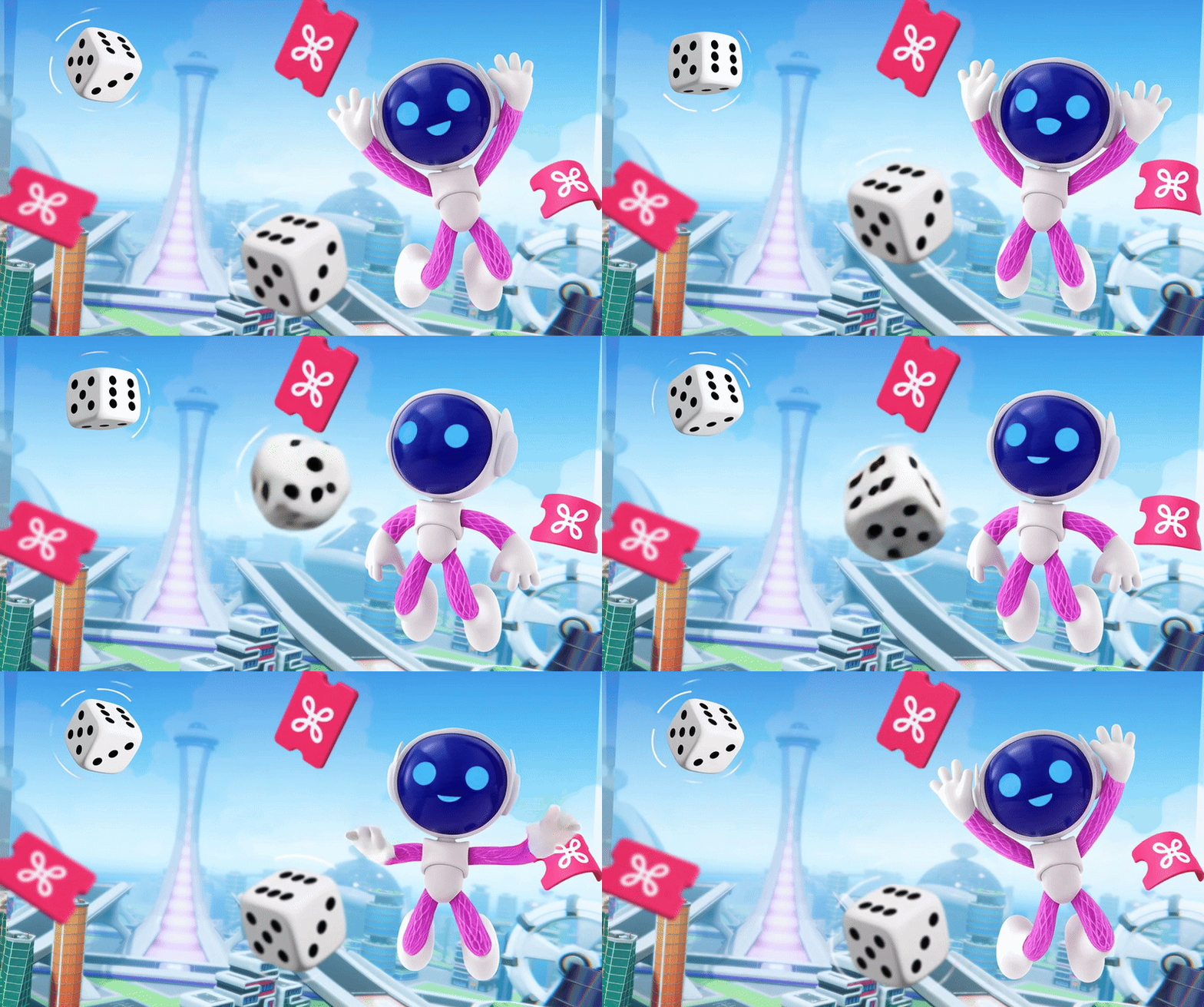
For Proximus we built a branded digital world for Proximus+ where customers returned to discover new areas, earn rewards, and personalise their digital environment. The mechanics were not designed as a campaign stunt. They were the core of how the product worked.

With the AvroTros Eurovision Voting App we built an experience where 141,000 users rated live performances, formed friend groups, and competed in quizzes. The social layer was not a feature. It was what made the app something people stayed in throughout the event rather than opening once to vote.

Why most brand platforms struggle here

The problem is not technology. It is a misunderstanding of what a digital product is supposed to do.

Brands often treat platforms as an extended landing page, a place where people go when a campaign is running. Consumer apps think the opposite way: they are designed to be the reason you pick up your phone.

This difference lives in the brief, not the build. When the goal is 'launch in time for the campaign', you build something different from when the goal is 'daily active users at six months'.

McDonald's Spain MyMcDonald's World is a good example of how this works when it is done right. We built a gamified 3D loyalty world inside the McDonald's Spain app. Mini-games, seasonal areas, and characters turned the app into a destination. Not just a discount channel.

HEMA Stapelgek showed the same principle in a shorter cycle: daily return, visible progress, and a social dimension through the app turned shopping trips into something to look forward to. The game mechanic was not the campaign. It was the product.

141kactive users during the Eurovision event
3xhigher return frequency in products with visible progress mechanics
no. 1in the App Store: the AvroTros Eurovision app

What brands can take from this

The lesson from TikTok, Duolingo, and Strava is not that you need to make viral content or add a streak. The lesson is that return visits are the result of a deliberate design decision made at the start of the project.

In practice this means:

  • Define the core action you want users to repeat before you design a single screen
  • Make progress visible and personal. People return for what feels like theirs
  • Build social connection in, not social sharing. There is a difference
  • Treat the first week as the product itself, not the campaign around it

At Livewall we call this the difference between a digital activation and a digital product. The first is designed for reach. The second is designed for behavior. Both have their place, but only the second builds real brand value with each return visit.

Look at your own brand platform. Does it give users a reason to come back tomorrow?

Livewall

Want to build a digital product people actually return to?

At Livewall we start with behavior, not a feature list. Whether it is a loyalty platform, a brand app, or a digital community, we design for the return visit. Get in touch and tell us what you want to build.

Get in touch with our team

What we do

Livewall builds brand experiences that people actually remember — interactive campaigns, loyalty platforms, digital products, and employer branding for ambitious brands.

Our work

We've worked with HEMA, Stabilo, Wehkamp, Efteling, 9292 and many others. Every project starts with the same question: what would make someone actually want to do this?

Talk to us

Working on something similar? We'd love to hear about it.

Contact Livewall →