


livewall
← All articles
Engagement10 March 2026·Livewall

How to measure campaign effectiveness beyond impressions and clicks

Impressions and click-through rates tell you almost nothing about whether a campaign actually worked. Here is the measurement framework we use to track real engagement impact.

campaignsbrand-activation

Impressions are cheap. Clicks are cheaper. And yet most campaign briefs still report on both as primary success metrics. We understand why: they are easy to collect, easy to present in a deck, and easy to compare with last month's numbers.

But they do not measure what you actually want to know. They measure exposure, not engagement. They measure whether someone saw something, not whether it changed anything.

At Livewall, we build interactive campaigns where participation is the primary signal, not reach. That means we measure differently too. Not because we want to discard traditional metrics, but because we want to supplement them with numbers that actually connect to commercial effect.

Audience engagement campaigns that drive real business results require a measurement framework built before the campaign launches, not assembled from whatever the reporting dashboard shows afterwards.

Livewall perspective

A campaign that generates ten million impressions but moves nobody to act has achieved nothing. A campaign that gets fifty thousand people genuinely participating and coming back has built something.

The four layers of campaign measurement

We work with four measurement layers. Each builds on the previous, and together they create a complete picture of whether a campaign worked.

Layer 1: Reach and exposure Your classic metrics: impressions, views, click-through rates. They are not worthless, but they sit at the top of the funnel. They tell you whether people saw the campaign, not what they did next. Use them as a baseline, not an endpoint.

Layer 2: Participation This is where it gets interesting. How many people actively participated? Not just clicked, but genuinely engaged. For how long? How many times? Did they play a game, complete a mechanic, share content? Participation metrics give you a far more reliable picture of engagement than clicks can.

Layer 3: Return behaviour A visit is a moment. Return is a relationship. We always look at D7 and D30 return rates: how many people come back within seven days, within thirty days? This is the metric that separates campaigns that flare up briefly from campaigns that build something durable.

Layer 4: Commercial impact Always the end goal. But it requires defining measurement points before the campaign goes live. Conversions, purchases, programme sign-ups, app downloads, NPS shifts. What behavioural change do you want to see? Decide that in advance, otherwise you have nothing to learn from after the campaign ends.

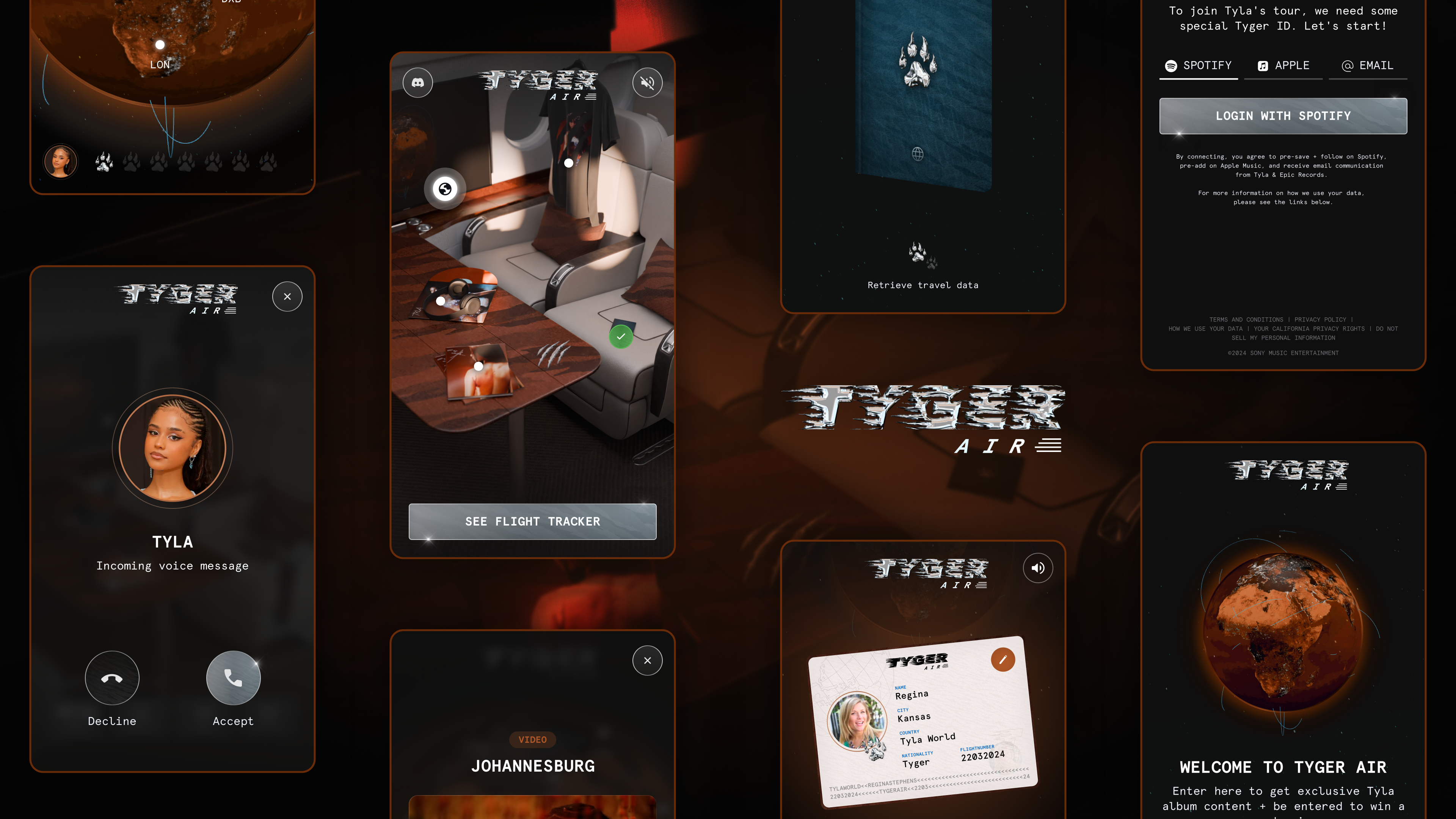
Tyger Air campaign for artist Tyla, an immersive 3D fan experience with gamification and personalised digital passports

Tyger Air: engagement measured on participation, return behaviour, and fan activation

What high-engagement campaigns teach us about measurement

For the Tyger Air campaign for artist Tyla, we built an immersive 3D fan experience with personalised digital passports. The objective was not to get as many people as possible to click a banner. The objective was to give fans something to participate in, something to keep, something to share.

The results we celebrated had nothing to do with click-through rates. We looked at session duration, the percentage of fans who downloaded their digital passport, organic social shares, and the ratio of one-time visitors to returning visitors.

We saw the same pattern with KLM Airmail, a Valentine's campaign where users created and sent personal messages. The strength of that campaign was not in impressions. It was in the time people invested in crafting their message, and in the fact that every share generated a new wave of organic reach.

Both campaigns were built from a clear participation objective. The measurement framework followed from that objective, not from whatever the platform made easy to track.

4-7xlonger session duration in interactive campaigns compared to passive ad formats
D7return rate is our core metric for measuring real audience engagement
60-80%of campaign conversions cannot be attributed to impressions or clicks alone

Setting campaign KPIs that measure actual impact

The concrete problem with campaign metrics is not that impressions are worthless. The problem is that they are used as the only metric. A proper measurement framework starts with one question: what behaviour do I want to change?

From that answer, you work backwards to measurement points:

  • If the goal is repeat purchases, measure return frequency and average order value.
  • If the goal is brand preference, measure quality scores in post-campaign surveys and organic search volume on brand terms.
  • If the goal is programme enrolment, measure conversion rate per participation moment, not per click.
  • If the goal is data collection, measure the quality and completeness of collected profiles, not sign-up counts.

For campaigns with gamified activations, we add behavioural metrics on top of those: how many game rounds does the average user play? At what point do people drop off? Which mechanics produce the highest return rates?

That data makes it possible not just to evaluate a campaign after it ends. It makes it possible to design the next one better.

Why participation-based campaigns are more measurable

One underrated advantage of interactive campaigns is that they naturally generate more measurement data. A banner campaign tells you whether someone clicked. A participation campaign tells you what someone did, for how long, how often, and what they shared afterwards.

At Livewall, we evaluate every campaign concept for its measurability before we build it. Before production starts, we always ask: how will we know after it ends whether this worked? If the answer is only impressions and clicks, that is a signal to rethink the concept.

Good campaign measurement requires building measurement points into the design itself. What actions does the system count? At which moments do we capture feedback? Which behavioural indicators connect to the commercial goal?

The campaigns that perform best over time are the ones built around behaviour you can measure. Not exposure you can count.

Livewall

Ready to build campaigns you can actually measure?

At Livewall, we design audience engagement campaigns around behaviour that matters, not metrics that are easy. Get in touch and we will show you how we build measurement into the campaign from the start.

Get in touch with our team

What we do

Livewall builds brand experiences that people actually remember — interactive campaigns, loyalty platforms, digital products, and employer branding for ambitious brands.

Our work

We've worked with HEMA, Stabilo, Wehkamp, Efteling, 9292 and many others. Every project starts with the same question: what would make someone actually want to do this?

Talk to us

Working on something similar? We'd love to hear about it.

Contact Livewall →