

livewall
← All articles
Strategy30 January 2026·Livewall

What makes a digital experience memorable when most are instantly forgotten

Memorable digital experiences share structural characteristics. They aren't random acts of creativity. Here's what they have in common.

brand-activationdigital-productsgamification

Most digital experiences are forgotten the moment the screen closes. People click through, play along briefly, move on. That's not bad luck. It's a design failure.

At Livewall, we've spent years building interactive brand experiences for consumer brands across retail, entertainment, FMCG, and music. What we've found consistently: the experiences that stick share a structural logic. They're not just creative. They're designed in a specific way.

Here are the five characteristics we see in digital experiences that people actually remember.
1. They ask something of you

Passive content disappears. Active participation stays.

When someone makes a choice, fills in an answer, or completes an action, the brain processes that information differently. More deeply. The sense of ownership begins the moment you contribute something, however small.

That's the core logic behind gamification marketing: not games for the sake of games, but mechanics that pull people into active participation. A campaign that demands input, choice, or effort is a campaign people remember.

2. They connect to something that already exists

The strongest digital experiences amplify emotions that are already there. Love for an artist. Pride in a sporting identity. Excitement about a new season.

That's fundamentally different from delivering a brand message and hoping it lands. When you connect to existing emotion, you don't need to generate that emotion. You just need to give it somewhere to go.

For the Warner Music Ed Sheeran campaign, we worked with the existing fanbase of one of the world's biggest artists. The digital experience built on something fans already felt deeply. That pre-existing emotional context is one of the biggest factors in how far an activation travels.

Warner Music Ed Sheeran Equals campaign

Warner Music x Ed Sheeran: connecting to existing emotion rather than trying to create it from scratch

3. They have a loop that pulls you back

An experience you visit once can make an impression. An experience that brings you back builds something.

The return loop doesn't need to be elaborate. A daily unlock. A progress bar. A new reveal. Small mechanisms that communicate: there is a reason to come back.

Proximus+ World was designed as a digital environment that offered something new on each visit, not a one-time spectacle. That same principle sits at the heart of effective loyalty programme design: reward what people do repeatedly, not just what they do once.

Livewall perspective

An experience you visit once can make an impression. An experience that brings you back builds something entirely different.

7xhigher return frequency in experiences with a daily engagement loop
3 minaverage session length in gamified activations versus 45 seconds for static content
62%of participants share an experience when it produces a personalised, shareable result

4. They produce something personal

An experience that's identical for everyone feels special to no one.

Personalisation doesn't have to be technically complex. A score, a badge, an individual profile, or a result that reflects your specific choices makes the experience feel like it belongs to you. That sense of ownership is exactly what makes people share.

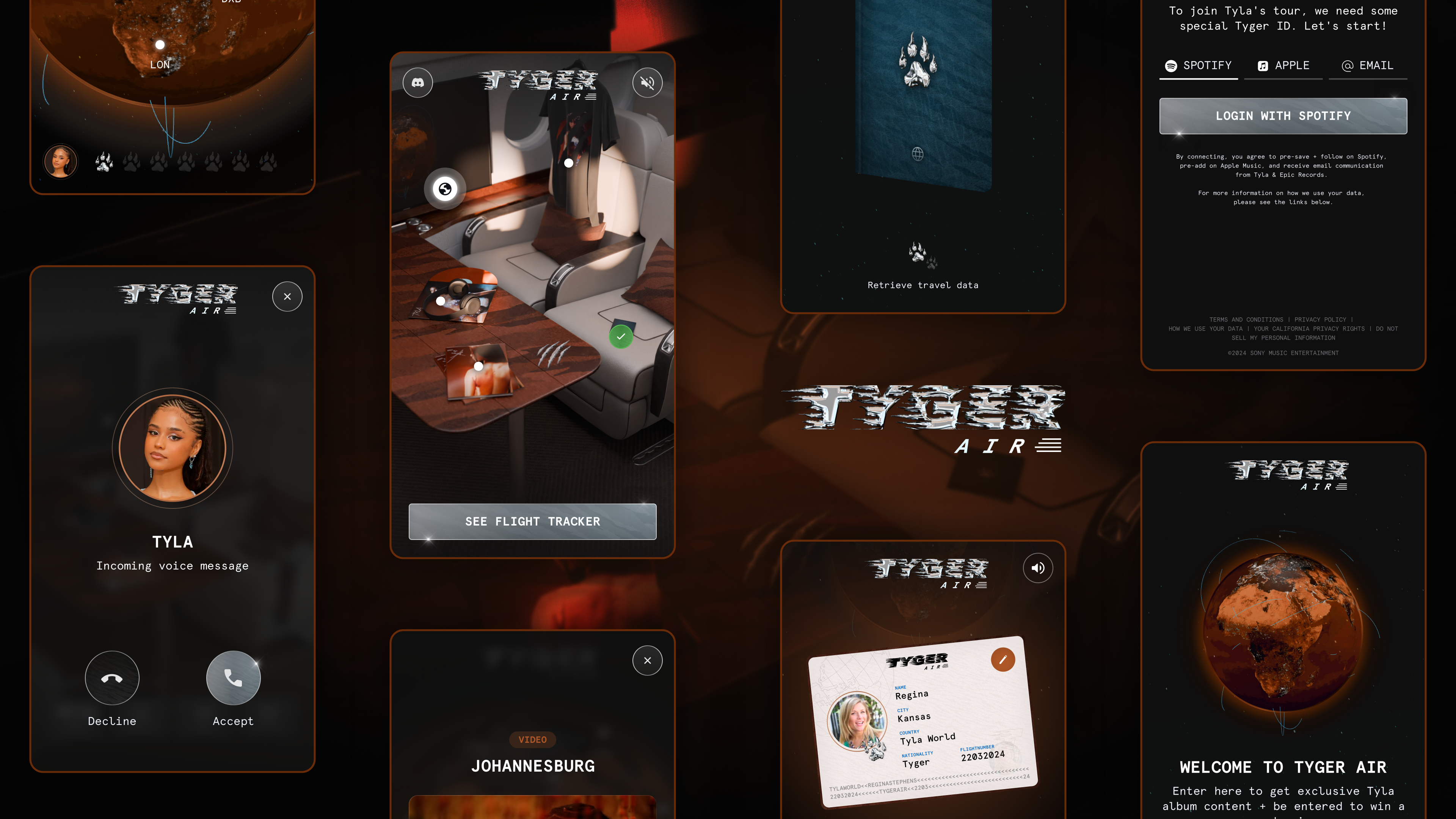
In the Tyger Air campaign for global artist Tyla, fans received a personalised digital passport based on their choices within the experience. The result was shareable, recognisable, and genuinely unique. That's not a finishing touch. It's a core design decision.

5. They're designed around one objective

One of the most common failure patterns we see: experiences that try to do too much.

Build awareness, collect data, position the brand, drive conversion, generate shares. Those are five different objectives. An experience designed to serve all five typically handles none of them well.

The interactive brand experiences we're most proud of at Livewall are built from a single behavioural question. What should someone do, feel, or decide as a result of this experience? Every design decision serves that one answer.

Decathlon Game had one clear purpose: help members discover their sports profile and translate that into a store visit. That focus made the design sharp and the results measurable.

Livewall

Want to build a digital experience people actually remember?

At Livewall, we combine behavioural design, gamification, and technology to build experiences that don't disappear. Tell us what you're working on and we'll show you what's possible.

Get in touch with our team

What we do

Livewall builds brand experiences that people actually remember — interactive campaigns, loyalty platforms, digital products, and employer branding for ambitious brands.

Our work

We've worked with HEMA, Stabilo, Wehkamp, Efteling, 9292 and many others. Every project starts with the same question: what would make someone actually want to do this?

Talk to us

Working on something similar? We'd love to hear about it.

Contact Livewall →