livewall
← All articles
Loyalty28 January 2026·Livewall

Loyalty app development: what makes a mobile programme sticky

A loyalty app that nobody opens is just wasted infrastructure. Here is what separates apps with daily active users from the ones that get deleted after the first reward.

loyalty-programsdigital-productsux

Most loyalty apps have a decent launch. Downloads on day one, a spike when the first reward lands, then silence. Seven out of ten loyalty apps have fewer than 10% active users after three months. The app is still live, the programme still runs, but nobody opens it anymore.

That is not a marketing problem. It is a design problem.

At Livewall, we design and build loyalty apps and mobile programmes for consumer brands. We have watched enough loyalty apps launch to know what separates daily active users from a stalled platform. It is rarely about technology. It is about the decisions made before a single line of code is written.

Livewall perspective

An app that only tracks points is not a loyalty app. It is a balance checker. People open it when they have to, not because they want to.

The wrong assumption at the start

Most brands begin with the wrong question. They ask: how do we build an app? The right question is: what gives someone a reason to open the app again tomorrow?

Most loyalty apps reward purchases only. Points per euro, a stamp at the till, a tier once you hit a threshold. That is a passive system. Users fall into it by buying something, not because the app itself pulls them back.

Stickiness does not come from points. It comes from habit formation. From a mechanic that draws people back even when they are not buying. That requires a different design perspective: behaviour first, technology second.

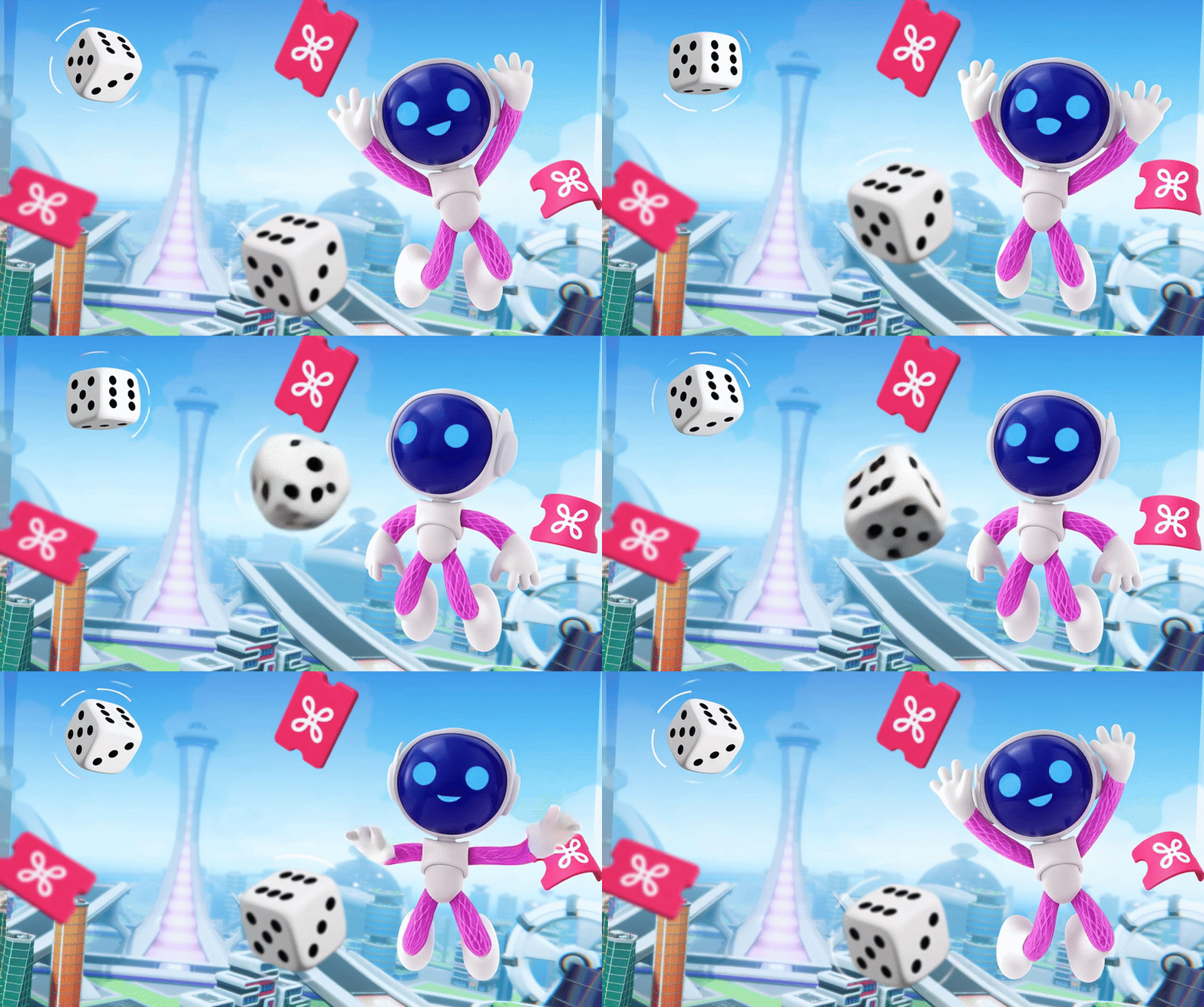
McDonald's Spain: a 3D loyalty world that keeps users returning long after the order

The five elements that make a loyalty app sticky

1. A daily return mechanic

The most powerful element in any high-performing loyalty app is something only available today. A daily challenge, a time-limited offer, a countdown. This principle underpins almost every app with high daily retention, from Duolingo to mobile games. It works in loyalty too.

For Rituals Advent Diorama, we built a daily return loop into a seasonal activation. Something new to discover every day, a new prize. The result was a retention curve that stayed almost flat throughout the entire campaign period.

2. Visible progress

People respond to progression. Not a balance that creeps upward, but a visible goal getting closer. A progress bar sitting at 70% creates a different emotional pull than a points total of 3,420.

Good loyalty app design makes progress visible across multiple time frames: per day, per week, per season. That gives users something to work toward at every stage, whether they joined yesterday or a year ago.

3. Rewards that actually mean something

This sounds obvious but is consistently done wrong. A 10% discount on your next purchase is not a reward. It is a coupon with a delay.

Real rewards are either exclusive, emotionally resonant, or functionally relevant at the right moment. Exclusivity works best: something only available through the app, not in store, not on the website. That gives the app its own value proposition.


4. Personalisation that feels like the app knows you

A loyalty app with personalised content consistently outperforms a generic one. Not because personalisation is magic, but because it creates relevance. When the app addresses you based on what you have done before, that feels different from a mass push notification.

This requires solid first-party data architecture behind the scenes. The app needs to learn from every interaction and translate that into relevant content. That is a build decision you need to make early in the loyalty app development process, not as an afterthought at launch.

5. Social proof and shared experience

A loyalty app does not need to be social to work, but the best-performing apps have a social element. Not mandatory leaderboards, but moments where you can share results or rewards. For Decathlon, the always-on loyalty mechanic translates into shareable movement moments that give the app context beyond the store.

higher daily retention in apps with a daily return mechanic versus purely transactional programmes
62%of loyalty app users open the app outside purchase moments when progression mechanics are present
more first-party data points per user through gamified loyalty versus standard points programmes

Technical choices that make or break stickiness

Beyond behavioural design, several technical choices have a direct impact on retention.

Load speed is everything. A loyalty app that takes more than two seconds to open loses users. Mobile users are impatient and the threshold for closing an app is low. Every technical millisecond matters.

Push notifications: less is more. Too many notifications lead to opt-out or deletion. The best loyalty apps send no more than three push messages a week, and only when there is something specific to say: a reward about to expire, a challenge created just for you.

Offline functionality. Users should be able to see their balance, progress, and rewards without an active connection. An app that shows a loading screen every time it opens is an app people stop opening.

At Livewall, we build loyalty platforms and apps where these technical considerations form part of the architecture decisions in the first sprint, not as an afterthought at launch.

Livewall

The best loyalty apps solve a daily problem or deliver a daily pleasure. Apps that only serve the loyalty programme get opened once a month.

Where it goes wrong in the brief

Most loyalty app stickiness problems start in the brief, not in the build.

Briefs that focus on features ('we want a points balance, a tier overview, a rewards catalogue') produce apps that contain those features. No reason to return daily, but all the expected functionality is present.

Briefs that focus on behaviour ('we want 40% of our members to open the app every week') force the team to think about the return loop before a single screen is designed. That is the difference.

Gamified loyalty as an approach always starts with that behaviour question. What behaviour do we want to change or reinforce? Then: what mechanic fits? Then: how do we build that in a way that is scalable and maintainable?

A loyalty app people open every day is not the result of more features. It is the result of better design questions.

Livewall

Building a loyalty app people actually open?

At Livewall, we design loyalty experiences that form daily habits, not apps that get forgotten after the first reward. Tell us what you are trying to achieve.

Get in touch with our team

What we do

Livewall builds brand experiences that people actually remember — interactive campaigns, loyalty platforms, digital products, and employer branding for ambitious brands.

Our work

We've worked with HEMA, Stabilo, Wehkamp, Efteling, 9292 and many others. Every project starts with the same question: what would make someone actually want to do this?

Talk to us

Working on something similar? We'd love to hear about it.

Contact Livewall →