


livewall
← All articles
Engagement3 March 2026·Livewall

Interactive storytelling: how narrative turns activations into experiences

Narrative gives activations context and emotion. Without it, even the cleverest mechanics feel like a quiz. Here's how to wire story into interactive design.

brand-activationcampaignsgamification

Most digital activations start with a mechanic. A game, a quiz, a collect-and-win. Then designers go looking for a theme to lay on top. That is the wrong order.

Narrative is not decoration. It is the reason someone participates, comes back, and tells others about the activation. Without story, you do not have a campaign. You have a function.

At Livewall, we see this repeatedly. Activations that are technically flawless but feel emotionally hollow. The mechanics work. Participation disappoints. The reason is almost always the same: there is no story pulling the user forward.

What story does that points cannot

Points, badges, and levels reward behaviour. Story gives that behaviour meaning. That is a fundamental difference.

When a user earns points, the question is: what for? When a user is inside a story, the question is: what happens next?

The second question is more powerful. It creates curiosity. It gives a reason to return that does not require a discount.

Take Tyger Air, the fan activation Livewall built around artist Tyla. Participants were not handed a generic game. They stepped into a world with its own identity, its own logic, its own feel. The game mechanics were there, but they served the experience. Not the other way around.

Or look at Doritos Step into the NetherLands, where a branded Minecraft world gave the film promotion a playable dimension. Fans did not "join a promotion". They walked into a universe.
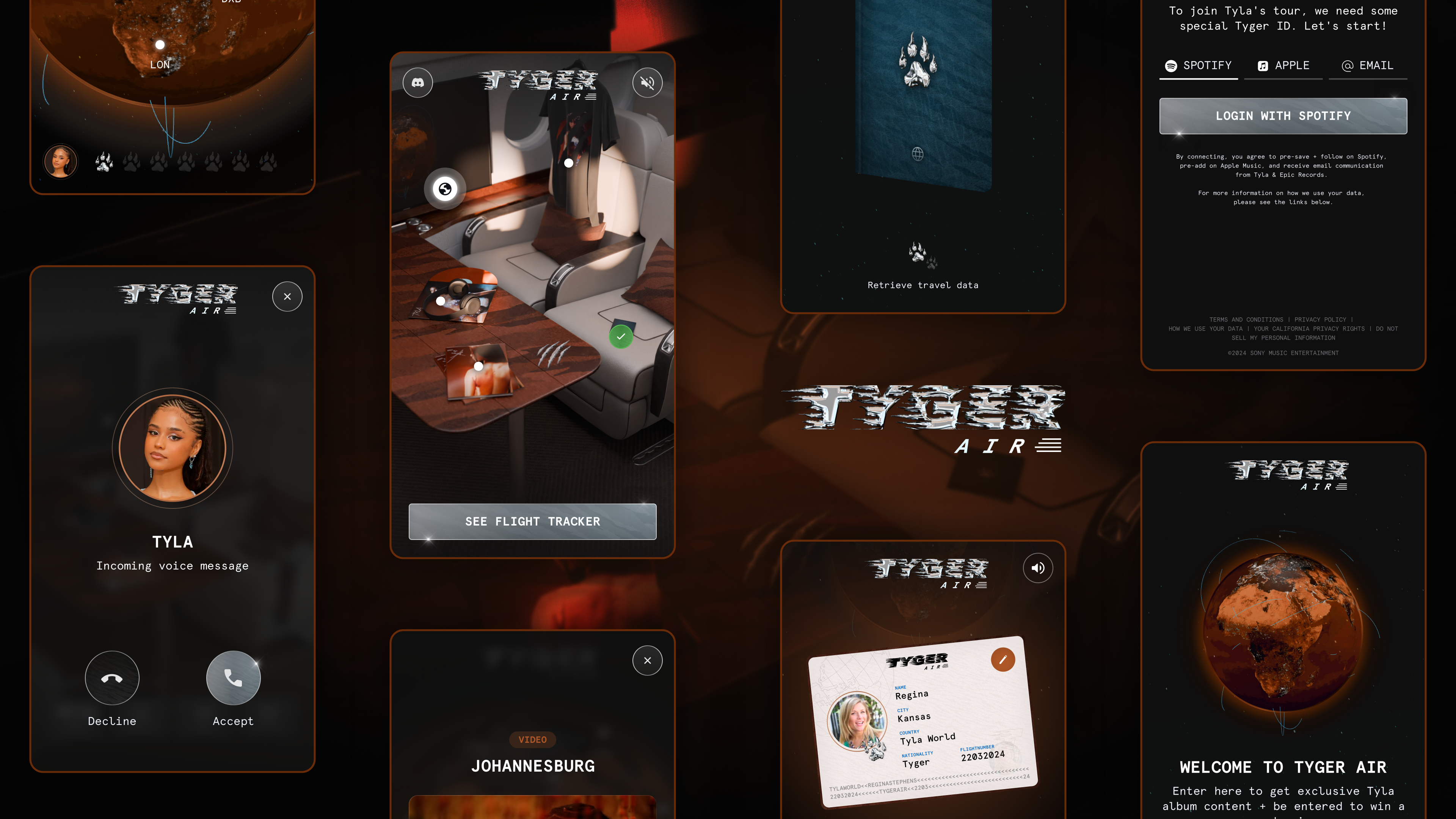
Tyger Air fan activation for artist Tyla

Tyger Air: a digital world with its own identity for Tyla's fanbase

Livewall perspective

Story is not decoration layered on top of a mechanic. It is the reason someone participates in the first place.

The three layers of narrative in an activation

Story works on three levels in a digital activation. You do not have to use all three, but choosing deliberately makes the difference.

1. The world The setting. The aesthetic. The atmosphere. This is the story someone experiences the moment they land on the page. Rituals does this well: every activation has its own world with its own visual language. Rituals Dream Collection placed users in a dreamlike environment, discovering products as they drifted through a surreal landscape. The world is the story.

2. The mission What does the user need to do, and why? A good mission is concrete, but has a story layer underneath. "Collect all stamps" is a task. "Help find the lost explorer" is a mission. The difference is emotional load. Participants want to go somewhere, not just accumulate something.

3. The progression What changes as you participate? Story means change. If an activation feels the same at the end as at the start, there is no story. Progression can be visual (the world expands), narrative (more context unfolds), or social (your choices have consequences others can see).

With Proximus+ World, we built a brand world that expanded the more users explored. Progression was built into the space itself. That gives participants a sense of ownership. They built something.

When the mechanic carries the story

Not every story needs to be explicit. Sometimes the mechanic tells the story itself.

The Warner Music Ed Sheeran Equals campaign was built around the album as a whole. Every interaction was a layer of the album. The story of the music and the story of the campaign were the same thing. Participants felt like they were getting closer to the artist. That feeling cannot be bought with a points system.

Or consider Martin Garrix Dream Team: the Spotify integration made each person's own listening history the starting point of the story. You and your friends, your music, your "team". Personalised narrative at scale.

This is the power of interactive storytelling: the story adapts to the participant, rather than the other way around.

The mistake brands keep making

The most common mistake is treating narrative as a marketing layer. Build a game, invent a character, and call that "story".

Real story drives design decisions. It determines which mechanics you choose, what progression looks like, which reward feels emotionally right. If narrative is added after the fact, it reads that way too.

At Livewall, we start with the feeling the user should take away. What should someone feel after five minutes? After three visits? That feeling is the story. Everything else is building.

3xhigher return rate in activations with a coherent narrative versus standalone mechanics
68%of participants share an activation more often when a story component is present
4xmore time spent in activations built as worlds rather than as forms

Story in loyalty activations

Loyalty programmes suffer most from the absence of story. Points systems are functional, but rarely compelling. Brands that load their loyalty activations with narrative see a fundamentally different participation pattern.

With HEMA Stapelgek, the activation was not just about points. There was a playable mechanic rooted in HEMA's brand identity. The feeling was familiar and playful at once. That is the power of story within loyalty: it makes the transaction part of something larger.

Wehkamp Wanna Have Days worked on the same principle. Customers came back daily not only for the discounts. They came back for the feeling of discovery. The story of "what is behind tomorrow's card" was strong enough to drive return behaviour without an extra discount.

That is the commercial value of story. It replaces the discount as the motivating force.

Practically: how to build story into your brief

You do not need to be a writer to think narratively. These are the questions we ask on every activation:

  • What emotion do we want to trigger in the first three seconds?
  • What changes for the user as they go further?
  • Is there a tension that motivates progress?
  • Does the end of the activation land emotionally on the setup from the start?

Those four questions produce a stronger brief than any technical overview of mechanics. They force you to think from the user outward, not from the mechanic inward.

In the brand activations Livewall designs, the narrative loop is always the starting point, never the finish. That single shift is the difference between an activation people remember and one they close as soon as they have played.

Livewall

Build an activation people actually remember

At Livewall, we start with the experience, not the mechanic. If you want to build something that genuinely moves people, let's talk about how narrative makes that possible.

Get in touch with our team

What we do

Livewall builds brand experiences that people actually remember — interactive campaigns, loyalty platforms, digital products, and employer branding for ambitious brands.

Our work

We've worked with HEMA, Stabilo, Wehkamp, Efteling, 9292 and many others. Every project starts with the same question: what would make someone actually want to do this?

Talk to us

Working on something similar? We'd love to hear about it.

Contact Livewall →