


livewall
← All articles
Loyalty16 January 2026·Livewall

How to design loyalty for subscription brands

Subscription brands face a loyalty problem most retailers do not: customers are already committed. Here is how to use that recurring relationship to build genuine long-term value.

loyalty-programscrmretention

The loyalty paradox of subscriptions

When someone signs up to a subscription, the hardest conversion moment is already done. They are paying every month. They are technically a customer. But that does not make them a loyal one.

Loyalty for subscription brands is not about driving a first purchase. It is about what happens next. Are people actively using the product? Do they understand the value they are getting? Do they look forward to their next billing cycle, or do they only notice the charge when they are already looking for a reason to cancel?

That gap between passive payment and active engagement is where churn lives. And the distance between those two states is larger than most subscription brands realise.

At Livewall, we work with subscription brands and loyalty-led businesses that take this distinction seriously. We see the same pattern again and again: brands that use loyalty mechanics to reinforce active usage consistently outperform brands that rely on price and convenience alone.
Livewall perspective

A subscription is not loyalty. It is an opportunity to earn loyalty, month after month.

Transactional versus experiential loyalty

Most loyalty programmes are built for transactional retail: buy more, earn more, save more. That model fits subscriptions badly. Your customer is already buying. The question is whether they stay.

Experiential loyalty works differently. Instead of incentivising the next purchase, it deepens the value perception of what someone already has. That looks like:

  • Progress mechanics that make visible how much someone has already achieved or used
  • Challenges and streaks that reward consistent engagement without forcing it
  • Personal milestones that make the relationship feel special and acknowledged
  • Exclusive access or content that makes subscribers feel they belong to something

The goal is not to generate more revenue per session. It is to turn passive payers into active users. Active users do not cancel.

Four retention strategies built for subscription brands

1. Design for activation, not just acquisition

The first weeks after sign-up are critical. Research consistently shows that subscribers who engage with a product's core value within the first 30 days are up to three times less likely to churn. But most subscription brands spend their loyalty budget on acquisition, not activation.

A well-designed onboarding flow that guides new subscribers through key usage moments is the cheapest form of retention strategy that exists.

2. Make the invisible visible

Subscribers forget how much value they are getting. That is not a philosophical problem, it is a design problem. Make usage visible. Surface accumulated value. Send periodic recaps that concretely show what someone has used, saved, or achieved.

Spotify Wrapped does not work because it is a fancy annual report. It works because it is a mirror. People see themselves in the data and feel validated in the choice they made.

3. Build community around the subscription

The strongest retention lever for many subscription brands is not the product itself but the community around it. Subscribers connected to other users are dramatically less likely to cancel, even during periods of lower personal usage.

Community platforms are not a nice-to-have for subscription brands. They are retention infrastructure.

4. Recognise the relationship, not just the transaction

Long-term subscribers are worth more than new ones. But most programmes treat them the same. Acknowledge anniversaries. Give long-standing members access to something exclusive. Make loyalty feel seen.

3xlower churn for subscribers who engage with core features early
40%higher lifetime value for members who participate in community mechanics
60%of churn is predictable from usage patterns, two weeks in advance

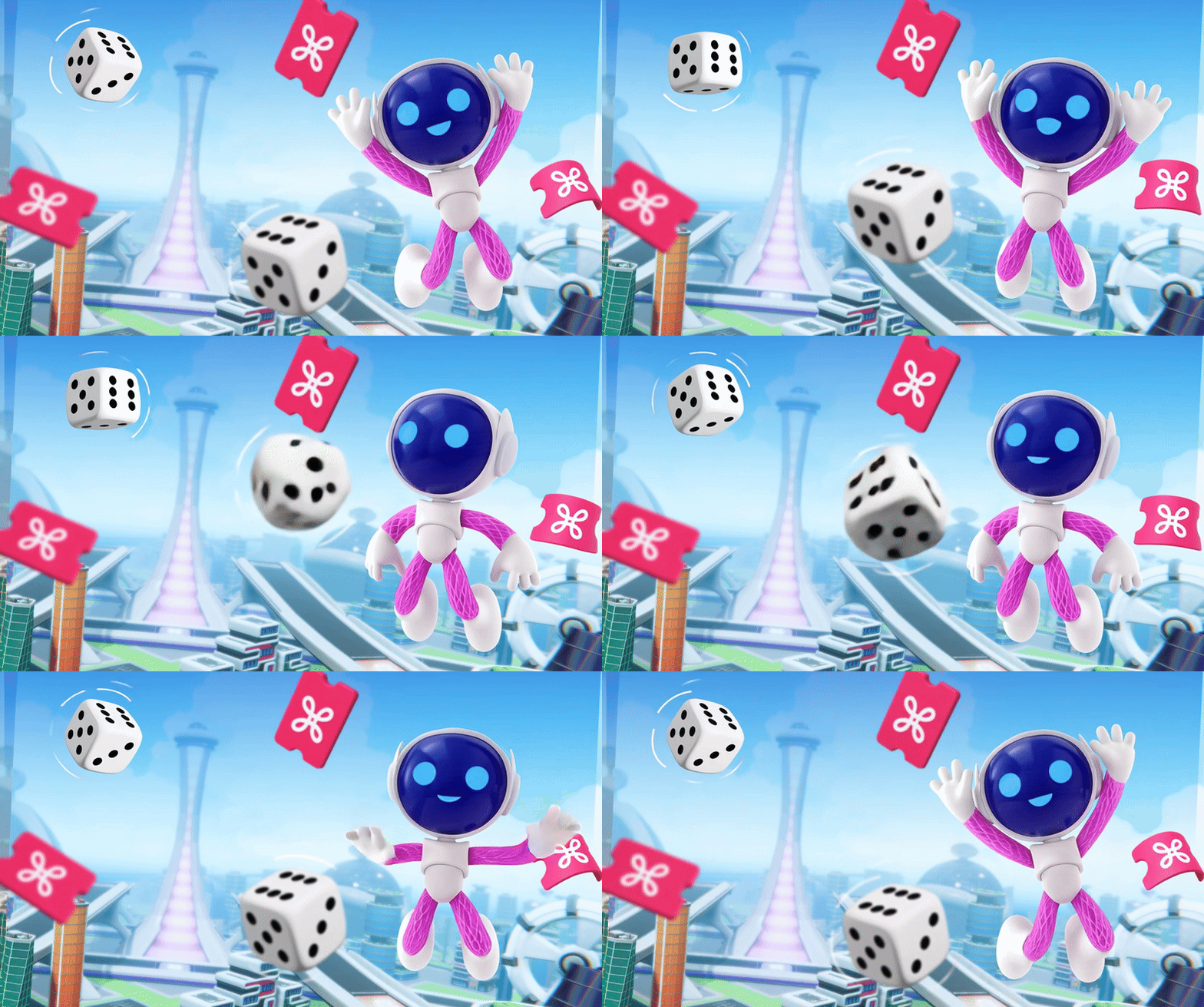
A gamified loyalty world that gives users a reason to return, even between purchase moments.

The role of gamification in subscription loyalty

Gamification gets a bad reputation in loyalty contexts when it is applied poorly. Points for purchases is not gamification. It is a discount programme with extra steps.

Real gamified loyalty changes behaviour because it makes actions that are good for the customer, and good for the brand, feel worth doing. That is the difference between a mechanic bolted onto a subscription and one that is embedded in the daily usage routine.

For subscription brands, these gamification patterns work reliably well:

  • Streaks: rewarding daily or weekly usage reinforces habit formation
  • Collection mechanics: accumulating something over time gives subscribers a reason to keep returning
  • Progress indicators: showing how far someone has come makes it harder to stop
  • Social comparison: knowing how you compare to others with similar subscriptions

We saw how HEMA Stapelgek drove daily return behaviour through collection mechanics, even among customers who rarely opened the app otherwise. The principle holds directly for subscription brands: give people something to come back to beyond the core product.

Similarly, the People's Postcode Lottery always-on programme shows how daily return can be baked into the subscription experience itself, making the product feel alive rather than static.

When loyalty mechanics backfire

Not every intervention helps. A few patterns Livewall has learned to avoid:

Complex point structures nobody understands. If a customer cannot explain how the system works in five seconds, you are using cognitive load as a reason to disengage, not to stay.

Rewards that attract the wrong subscribers. Discount-focused mechanics attract price-sensitive subscribers who leave at the first better offer. Value-based rewards, exclusive experiences, early access, retain the customers worth keeping.

Pressure without context. Push notifications saying "you are about to lose your streak" work as a reminder for someone who loves the programme. They work as an irritant for someone already reconsidering.

Good loyalty programme design does not start with the mechanic. It starts with understanding the behavioural patterns that lead to churn, then designing systems that interrupt those patterns.

Livewall

Design loyalty that earns the next month

At Livewall, we design and build loyalty systems that earn return rather than demand it. Whether you need to reduce churn, improve activation, or build a retention strategy from scratch, we would like to help.

Get in touch with our team

What we do

Livewall builds brand experiences that people actually remember — interactive campaigns, loyalty platforms, digital products, and employer branding for ambitious brands.

Our work

We've worked with HEMA, Stabilo, Wehkamp, Efteling, 9292 and many others. Every project starts with the same question: what would make someone actually want to do this?

Talk to us

Working on something similar? We'd love to hear about it.

Contact Livewall →