

livewall
← All articles
Loyalty20 April 2026·Livewall

How to design a loyalty programme that rewards non-purchase behaviours

Reviews, referrals, social shares, and survey responses are all high-value actions for a brand. Here is how to reward them without devaluing the purchase reward.

loyalty-programsgamificationcrm

Most loyalty programmes reward one thing: the transaction. Spend money, earn points. It makes sense on paper, but it leaves an enormous amount of value on the table. The actions that actually drive brand growth, writing a review, referring a friend, filling in a preference survey, completing a brand challenge, rarely earn a single point.

At Livewall, we've seen this pattern across retail, FMCG, telco, and entertainment. Brands that build their loyalty programme entirely around transactions miss the behavioural signals that matter most for CRM enrichment, word-of-mouth growth, and long-term retention. Engagement-based rewards are not a nice-to-have layer. They are a strategic decision about which customer behaviours your programme reinforces.

Here is how to design a programme that rewards the full range of valuable customer actions, without undermining what you already have.

Livewall perspective

A verified customer review drives more new purchase intent than most discount vouchers. Yet most programmes reward the voucher and ignore the review.

Step 1: define which non-purchase actions are actually worth rewarding

Not every engagement action deserves the same treatment. Before you touch point values, group non-purchase actions by what they deliver:

Brand value actions — reviews, testimonials, user-generated content, social shares. High brand awareness impact, measurable influence on new customer conversion, hard to quantify directly but significant at scale.

Data actions — profile completion, preference surveys, quiz participation, poll responses. Directly valuable for CRM segmentation, personalisation, and campaign targeting. Every filled data field reduces your reliance on assumptions.

Acquisition actions — referrals, friend invitations, ambassador programme participation. These have the clearest commercial value. Referred customers have a materially higher lifetime value and lower acquisition cost than cold traffic.

Each category deserves its own reward logic. Grouping them together produces confusion and dilution.

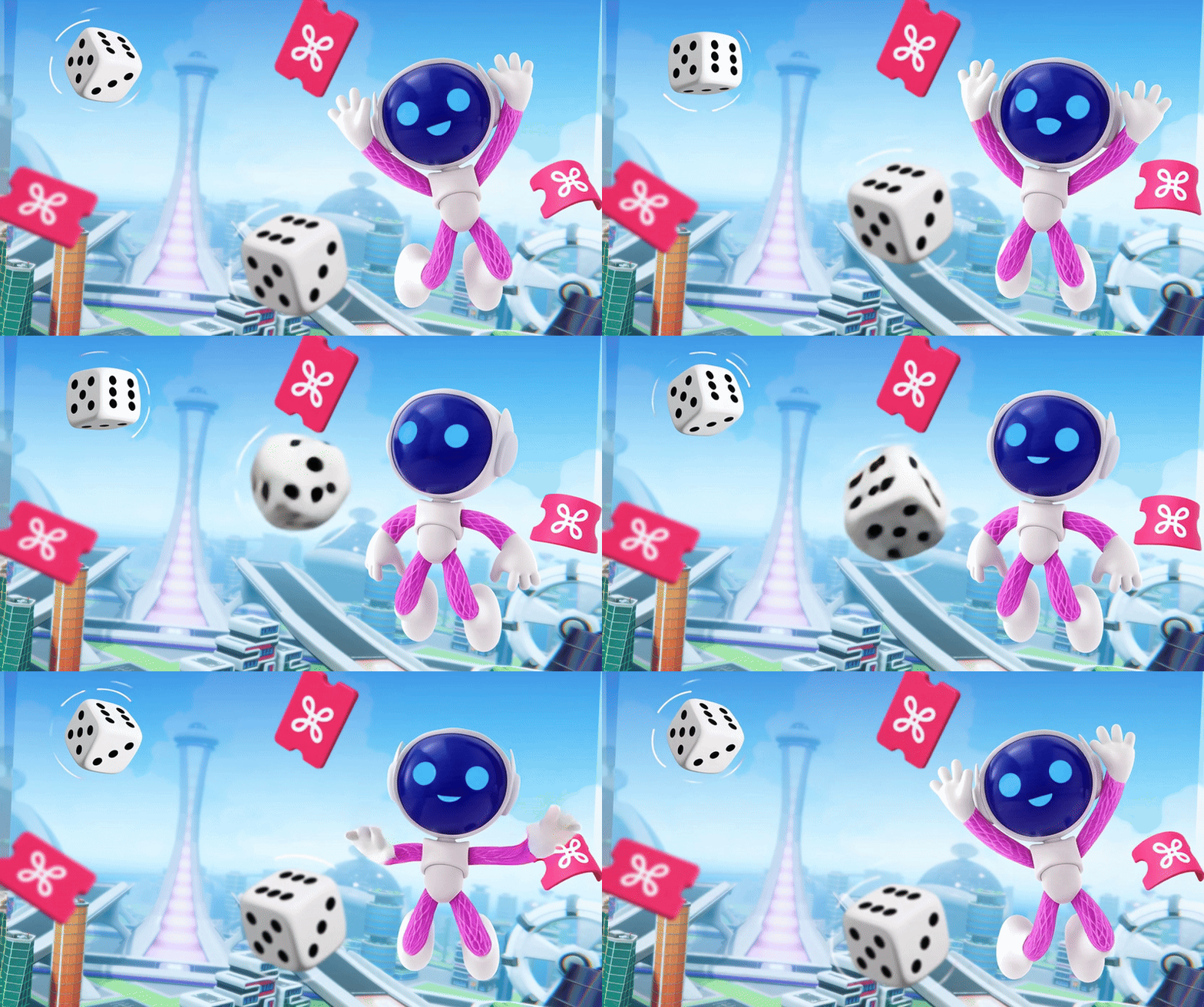
HEMA Stapelgek gamified loyalty campaign

HEMA Stapelgek made non-purchase actions a structural part of the loyalty experience, not an afterthought.

Step 2: set point values that protect purchase primacy

This is where most programmes go wrong. Brands assign the same points to a 50-euro purchase and a 30-second survey. That makes the programme feel arbitrary to your most valuable buyers.

The principle we use at Livewall: non-purchase actions should not exceed 20 to 30 percent of the total points an active buyer could earn in a month. The purchase remains the anchor. Everything else is meaningful but subordinate.

Set point values against three variables:

  • Effort required — how much time and attention does the action ask for?
  • Brand value delivered — what does it return commercially or strategically?
  • Frequency potential — how often can a member realistically perform this action?

A verified review is worth more than a basic profile field. A referral that converts to a purchase is worth more still. A social share with no tracking is worth the least. Build that hierarchy explicitly into your earn structure.

Step 3: make non-purchase actions visible and inviting

The biggest barrier is not the point structure. It is visibility. Most loyalty members have no idea they can earn points for a review or a referral because the option is buried three levels deep in an account dashboard.

What actually works: surface non-purchase actions as a live, active part of the member experience. That means:

  • An activity feed with available challenges, similar to what you'd see in a game
  • Triggered messages at the right moment, such as a review request three days post-purchase
  • Progress indicators showing how many points remain to the next tier or reward
  • Time-limited challenges to create urgency without pressure

In our work on the Decathlon always-on loyalty programme, surfacing non-transactional behaviours like activity logging and community participation alongside purchase rewards produced higher programme retention and far richer customer profiles. Gamified loyalty makes this feel natural because the mechanics communicate the value clearly without needing to explain the rules.

Step 4: wire non-purchase actions into your CRM strategy

Every non-purchase action is a data event. A product review signals category interest. A completed preference profile enables meaningful personalisation. A referral identifies your brand advocates.

That data is only useful if your CRM is built to act on it. Design the connection before you launch:

  • Which segments do you activate based on which behaviours?
  • What automated triggers fire after a non-purchase action is completed?
  • How do you measure the lifetime value difference between transactional-only members and those who engage beyond purchase?

Programmes that instrument this well consistently show that members who complete non-purchase actions retain at significantly higher rates. Not because they spend more in the short term, but because their relationship with the brand extends beyond the transaction.

2.4xhigher retention among members who complete non-purchase actions
38%richer customer profiles through behavioural data beyond transactions
3xhigher CLV for referred customers versus cold acquisition

Step 5: launch small, measure fast, then build

Starting with five different non-purchase action types simultaneously is a recipe for confusion on every side. Start with two or three, measure which perform best, then expand.

Good starting points:

  1. Post-purchase review prompt — high brand value, easy to trigger from the purchase flow, immediately connectable to your CRM
  2. Profile enrichment — ask members about preferences in exchange for bonus points; the data pays back immediately in targeting quality
  3. Referral mechanic — simple to communicate, clear commercial value, easy to measure

The Proximus+ World case demonstrates how an existing loyalty programme can expand into brand engagement well beyond the core service, without diluting the transactional foundation.

Livewall designs and builds loyalty programmes that recognise customer behaviour across the full relationship, not just at the point of sale. If your current programme only rewards the transaction, you are leaving both data and loyalty on the table.

Livewall

Ready to reward more than the purchase?

At Livewall we design and build loyalty programmes that recognise the full range of customer behaviour, from point strategy to platform. One team, built around your objectives.

Get in touch with our team

What we do

Livewall builds brand experiences that people actually remember — interactive campaigns, loyalty platforms, digital products, and employer branding for ambitious brands.

Our work

We've worked with HEMA, Stabilo, Wehkamp, Efteling, 9292 and many others. Every project starts with the same question: what would make someone actually want to do this?

Talk to us

Working on something similar? We'd love to hear about it.

Contact Livewall →